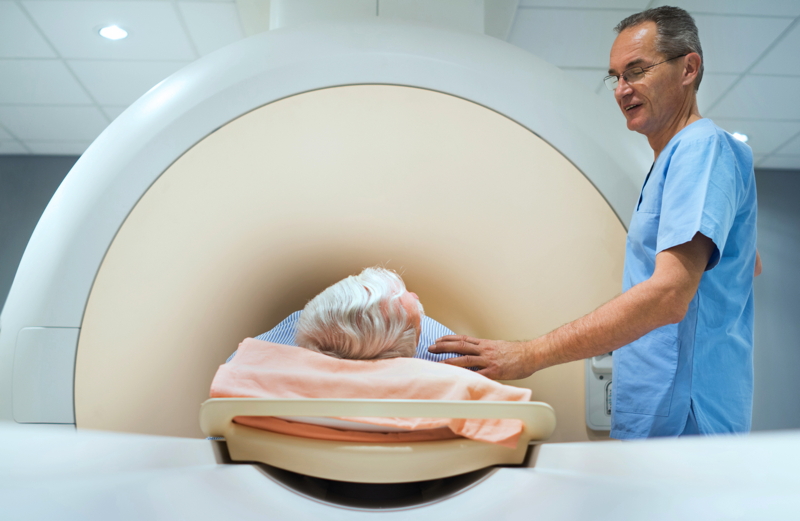
IMAGING
Seeing what’s happening inside your body can help you and your doctors make the best treatment plan.
Imaging uses special machines to create pictures of the inside of your body. These pictures can:
-
Show the size of the prostate cancer and where it is in the body
-
Help plan a biopsy or treatment
-
Check how well treatment is working
-
Monitor for any signs the cancer has returned or spread
Not every man needs imaging. If your cancer is considered low-risk, your doctor may decide it isn’t necessary.
Ultrasound
Ultrasound uses sound waves to create pictures of your prostate. It’s often used to guide biopsies (when small tissue samples are taken to check for cancer).
Types of Ultrasound:
-
Standard Ultrasound (TRUS): A small probe about the size of a finger is placed in the rectum to take images.
-
Color Doppler Ultrasound: Measures blood flow. Tumors often have more blood vessels, which can help identify suspicious areas.
-
Contrast-Enhanced Doppler Ultrasound: Involves a safe injection of a “contrast agent” to make blood flow patterns clearer.
-
Transrectal Elastosonography (TRES): Measures how stiff prostate tissue is—tumors are usually firmer than normal tissue.
-
Micro-Ultrasound: Creates highly detailed images and can guide a biopsy with greater accuracy.
Magnetic Resonance Imaging (MRI)
MRI uses powerful magnets and radio waves to create clear, detailed pictures of the prostate and surrounding tissues.
How MRI Helps:
-
Shows cancer within the prostate and nearby areas (like lymph nodes or pelvic bones)
-
Can be used before a biopsy to target suspicious spots
-
Can be combined with ultrasound during a biopsy for more precise targeting
-
Helps plan treatment and check for recurrence
Sometimes, a contrast dye called gadolinium is injected to make images clearer. MRI does not use radiation.
Bone Scan
A bone scan checks if cancer has spread (or metastasized) to your bones. It uses a small amount of a radioactive tracer injected into your bloodstream. A special camera detects where the tracer collects—cancer-affected areas often show up as bright spots.
Bone scans may be recommended if you:
-
Have bone pain
-
Have test results suggesting possible bone spread
-
Are at higher risk for bone metastases
Computed Tomography (CT) Scan
A CT scan takes many X-ray images from different angles and combines them into a detailed, cross-section picture.
Uses:
-
Checks lymph nodes and surrounding tissues
-
Shows the extent of cancer
-
Helps guide some treatments
A contrast dye may be injected to make details clearer.
Positron Emission Tomography (PET) Scan
A PET scan uses a small amount of radioactive tracer injected into your bloodstream. The tracer is absorbed more by cancer cells than healthy cells, and a special camera creates images showing cancer as “bright spots.”
Types of Tracers:
-
FDG, Fluciclovine F18, Sodium Fluoride F18, Choline C11
PET scans are often combined with a CT or MRI for more complete information.
Prostate-Specific Membrane Antigen Positron Emission Tomography (PSMA-PET)
PSMA-PET is a protein found in large amounts on prostate cancer cells. Special tracers GA 68 PSMA-11, 18F-DCFPyl, and 18F-rhPSMA-7.3 attach to PSMA, making prostate cancer cells easier to see on a PET scan.
Why It’s Used:
-
To find out how far prostate cancer has spread
-
To detect recurrence (cancer coming back) when PSA levels rise