
STAGING
Staging
Staging describes how far prostate cancer has spread. Knowing your stage helps your care team choose the most effective treatment and predict outcomes.
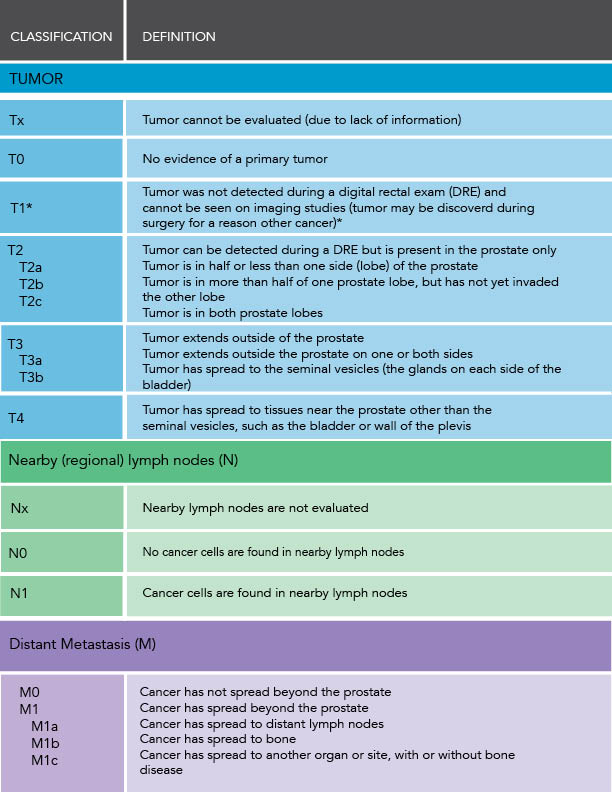
The American Joint Committee on Cancer (AJCC) TNM system is the most widely used staging method for prostate cancer. It combines five key pieces of information:
-
Size and extent of the primary tumor (T category)
-
Spread to nearby lymph nodes (N category)
-
Spread to distant sites (M category)
-
PSA level at diagnosis
-
Gleason Score
These factors are used together to assign an overall stage, from Stage I (least advanced) to Stage IV (most advanced).
1. The size and extent of the primary Tumor (T category)
T0 – No tumor can be detected.
T1 – The tumor is not detectable with a digital rectal exam (DRE) or imaging but is found in prostate tissue from a biopsy or surgical treatment.
- T1a – Cancer is found in 5% or less of the removal tissue.
- T1b – Cancer is found in more than 5% of the removed tissue.
- T1c – Tumors are found in one or both sides of the prostate.
T2 – The tumor is detectable with a DRE or imaging but is confined to the prostate.
- T2a – Cancer is in no more than one-half of one side of the prostate.
- T2b – Cancer is in more than half of one side of the prostate.
- T2c – Cancer is in both sides of the prostate.
T3 – Cancer has grown outside the prostate and may have grown into the seminal vesicles.
- T3a – Cancer has spread outside the prostate but not to the seminal vesicles.
- T3b – Cancer has spread to the seminal vesicles.
T4 – Cancer has grown into other nearby tissues, such as the urethral sphincter, rectum, bladder or wall of the pelvis.
2. Whether the cancer has spread to nearby lymph Nodes (N Category)
- NX – The lymph nodes have not been assessed for cancer.
- N0 – There is no cancer in nearby lymph nodes.
- N1 – Cancer has spread to nearby lymph nodes.
3. The absence or presence of cancer outside the prostate, or Metastasis (M Category)
- MX – It is unknown if cancer has spread to distant sites.
- M0 – The cancer has not spread to distant sites.
- M1 – Cancer has spread to distant sites.
- M1a – Cancer has spread to distant lymph nodes.
- M1b – Cancer has spread to bones.
- M1c – Cancer has spread to distant organs.
4. The PSA level at the time of diagnosis.
PSA levels at diagnosis are an important prognostic factor. In general, the higher the PSA, the greater the likelihood of more advanced disease and a poorer prognosis. PSA helps guide staging and treatment decisions when considered alongside Gleason score and clinical stage.
5. The Gleason Score and Grade Group
The Gleason Score describes how abnormal prostate cancer cells appear under a microscope compared with normal prostate tissue. It helps doctors estimate how quickly the cancer may grow and spread.
The score is based on the two most common patterns of cancer cells seen in the biopsy. Each pattern is graded on a scale from 3 to 5, where 3 looks more like normal tissue and 5 looks very abnormal.
These two numbers are then added together to form the Gleason Score, which ranges from 6 to 10. For example, in a Gleason 4+3, the first number (4) represents the dominant pattern and the second number (3) represents the next most common pattern. A higher total score indicates a more aggressive cancer.
To make this easier to understand, doctors now also use a simplified system called the Grade Group, which ranges from 1 to 5:
- Grade Group 1 (Gleason 6): Cancer cells look relatively similar to normal cells and are considered low grade.
- Grade Group 2 (Gleason 3+4=7): Mostly low-grade cells, with some higher-grade areas.
- Grade Group 3 (Gleason 4+3=7): More high-grade cells, considered intermediate risk.
- Grade Group 4 (Gleason 8): High-grade cancer, more likely to grow and spread.
- Grade Group 5 (Gleason 9–10): Very high-grade cancer that tends to be aggressive.
Taken together with PSA level and imaging results, the Gleason Score or Grade Group helps determine the overall stage of prostate cancer. The stage is usually expressed in Roman numerals from I (the least advanced) to IV (the most advanced). The AJCC TNM staging system—which looks at the tumor (T), lymph nodes (N), and metastasis (M)—remains the most widely used method and plays a key role in treatment planning.
Prostate cancer is also classified into four stages ranging from I to IV based on the extent of cancer spread. The lower the stage number, the less the cancer has spread, and the higher the number, the more it has spread. People with similar stages of cancer have similar treatment outlooks even if their experiences are unique.
Stages of Prostate Cancer
Grouping TNM results into stages makes it easier to understand your outlook and treatment options.
- Stage I Cancer is small, confined to the prostate, low PSA, and low Grade Group.
- Stage II Cancer is confined to the prostate but may be larger or have a higher Grade Group.
- Stage III Cancer has grown outside the prostate or into seminal vesicles.
- Stage IV Cancer has spread to lymph nodes, bones, or other organs.
However, staging in prostate cancer can be complex, and it is best to talk to your care team to help explain what your stage means for you and your treatment options.