
GLEASON SCORE
Prostate Cancer Grading & Prognostic Scoring
The Gleason Score is the grading system used to determine the aggressiveness of prostate cancer. This grading system can be used to choose appropriate treatment options. It’s based on how cancer cells look under a microscope and helps determine how likely the cancer is to grow and spread.
Prostate tumors contain cancer cells with different growth patterns. For each patient, two patterns are assigned:
-
Primary pattern: The pattern seen in the largest area of the tumor
-
Secondary pattern: The next most common pattern in the tumor
These two numbers are added together to get the Gleason Score.
Gleason Scores range from 6-10
The higher the Gleason Score, the more likely that the cancer will grow and spread quickly.
- Gleason 6 or less: Low-risk cancer, less aggressive and likely to grow slowly
- Gleason 7: Indicates an intermediate risk for cancer. This score is made up of two numbers: the primary score (the most common cancer pattern seen) and the secondary score (the next most common pattern). A score can be of 3+4 or 4+3. A score of 4+3 is considered more concerning and is more aggressive.
- 8–10: High-risk cancer, very aggressive and more likely to spread quickly
How Important is the Gleason Score?
The Gleason Score is very useful for predicting the behavior of prostate cancer. However, other factors also contribute to determining the stage and risk group of prostate cancer, including:
- The PSA level
- Findings from a digital rectal exam
- The number of biopsy core samples that contain cancer
- If the cancer has spread outside the prostate
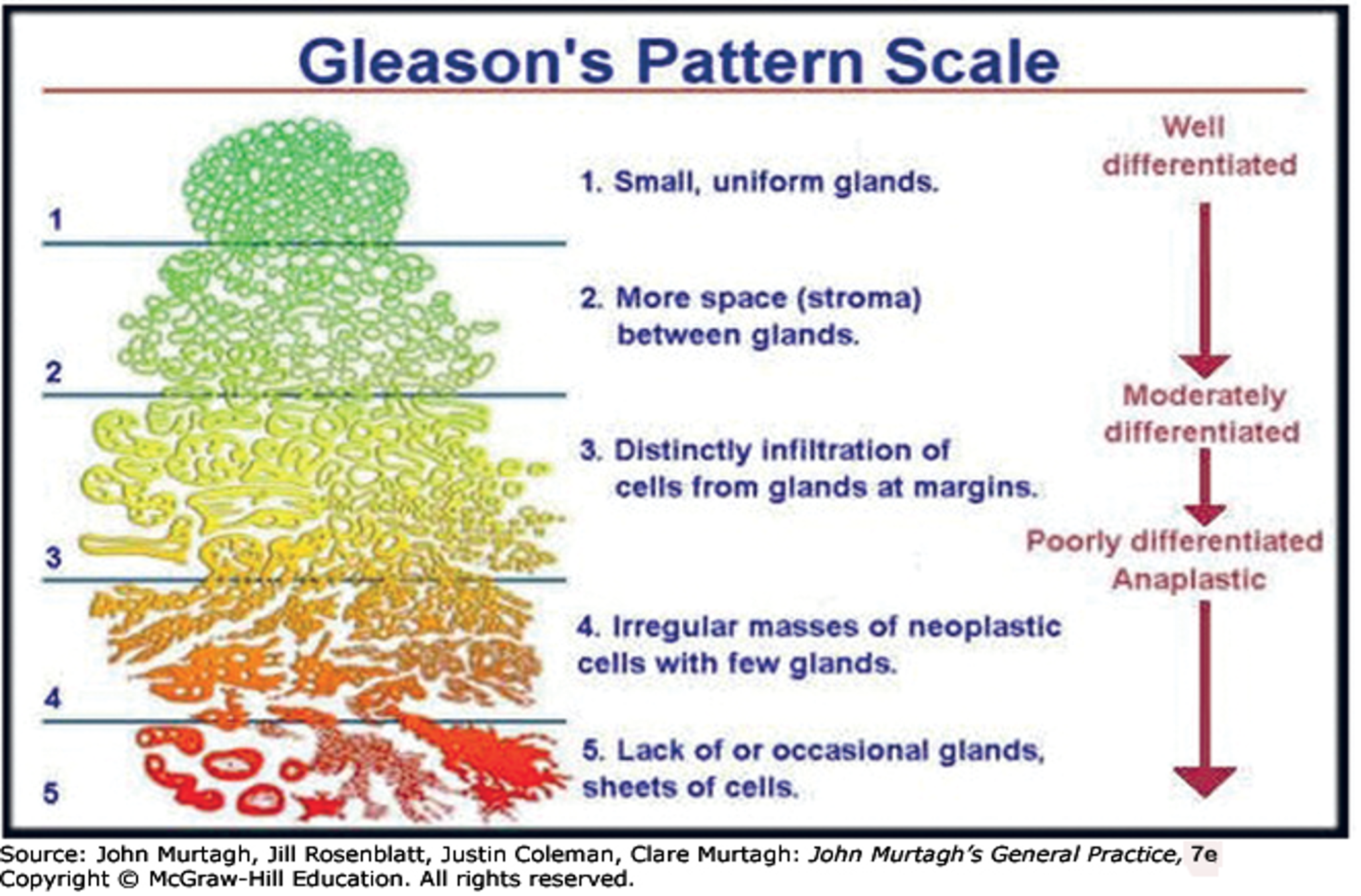
Prostate Cancer Grading System (Before 2014)
Before the newer system was introduced, Gleason Scores were described only by their sum, without a standardized grouping. This sometimes led to confusion, especially for men with Gleason 6 disease, which sounds “medium” but is the lowest grade cancer found on biopsy.
Old scale key points:
-
Scores ranged from 2 to 10, though 2–5 are rarely diagnosed today.
-
6 was considered “low grade” cancer.
-
7 could mean 3+4 (better outlook) or 4+3 (less favorable).
-
8–10 indicated high-grade, aggressive cancer.
-
The system relied heavily on patient and provider interpretation without a clear risk category label.
Updated Prostate Cancer Grading System
The updated prostate grading system is an extension of the current Gleason grading scale for determining the stage of prostate cancer. This system is designed to provide a simplified and more accurate grading stratification system than the current Gleason Score. This new method is especially focused on better representing low-grade disease to reduce unnecessary treatment of indolent prostate cancer. The new grading system still uses the Gleason patterns but simplifies results into five Grade Groups:
Traditional Gleason Score
New Grading System Group 1
GLEASON 3+3=6
Only individual discrete well-formed glands.
GRADE 1
GLEASON 3+4=7
Predominantly well-formed glands with a lesser component of poorly-formed/fused/cribiform glands.
GRADE 2
GLEASON 4+3=7
Predominantly poorly-formed/fused/cribiform glands with a lesser component of well-formed glands.
GRADE 3
GLEASON 4+4=8
Only poorly-formed/fused/cribiform glands or
- Predominantly well-formed glands with a lesser component lacking or
- Predominantly lacking glands with a lesser component of well-formed glands.
GRADE 4
GLEASON 9-10
Lacks gland formation (or with necrosis) with or without poorly-formed/fused/cribiform gland.
GRADE 5